Skip to content
When a customer increases their order and wants to open a new 72-cavity beverage cap mold from the original 48 cavities, our design faces a series of complex technical challenges:
Ensuring Plastic Flowability:
In a 72-cavity mold, each cavity must receive the same pressure. Otherwise, uneven pressure will result in uneven plastic flow. This requires mold flow analysis and proper hot runner design. If the hot runner is not properly designed, burrs will form at the gate, and areas far from the gate will not be filled.

Simultaneous Cooling:
Preventing Deformation Due to Cavities at the Edges
Doubling the number of cavities results in higher temperatures and slower heat dissipation in the center of the mold, while the edges cool faster, potentially causing deformation.
It is also recommended that customers upgrade their injection molding machine to a 420-ton or higher machine to ensure compatibility with the mold.
The mold’s lifespan remains the same as before:
the increase in size will not reduce its lifespan. Each injection nozzle is independent, ensuring simultaneous heating and cooling to prevent deformation.
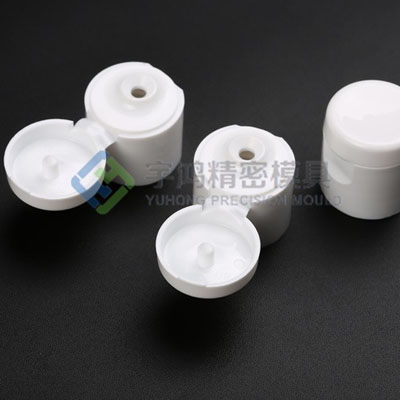
Our bottle cap injection molding clients span industries including bottled water, carbonated beverages, edible oil, cosmetics, milk powder caps, hand sanitizer pump heads, anti-theft inner cap molds, centrifuge tube molds, and transfer tip molds, among others.